WRITING OUTDOORS
In a digital landscape where it is easier to see nature pixelated on a screen versus stepping outside into the world, it is understandable why many people have forgotten the fundamental necessity of spending time outside. Fresh air and nature have been proven to be beneficial for our health, but we tend to neglect this reprieve from the demand of industry.
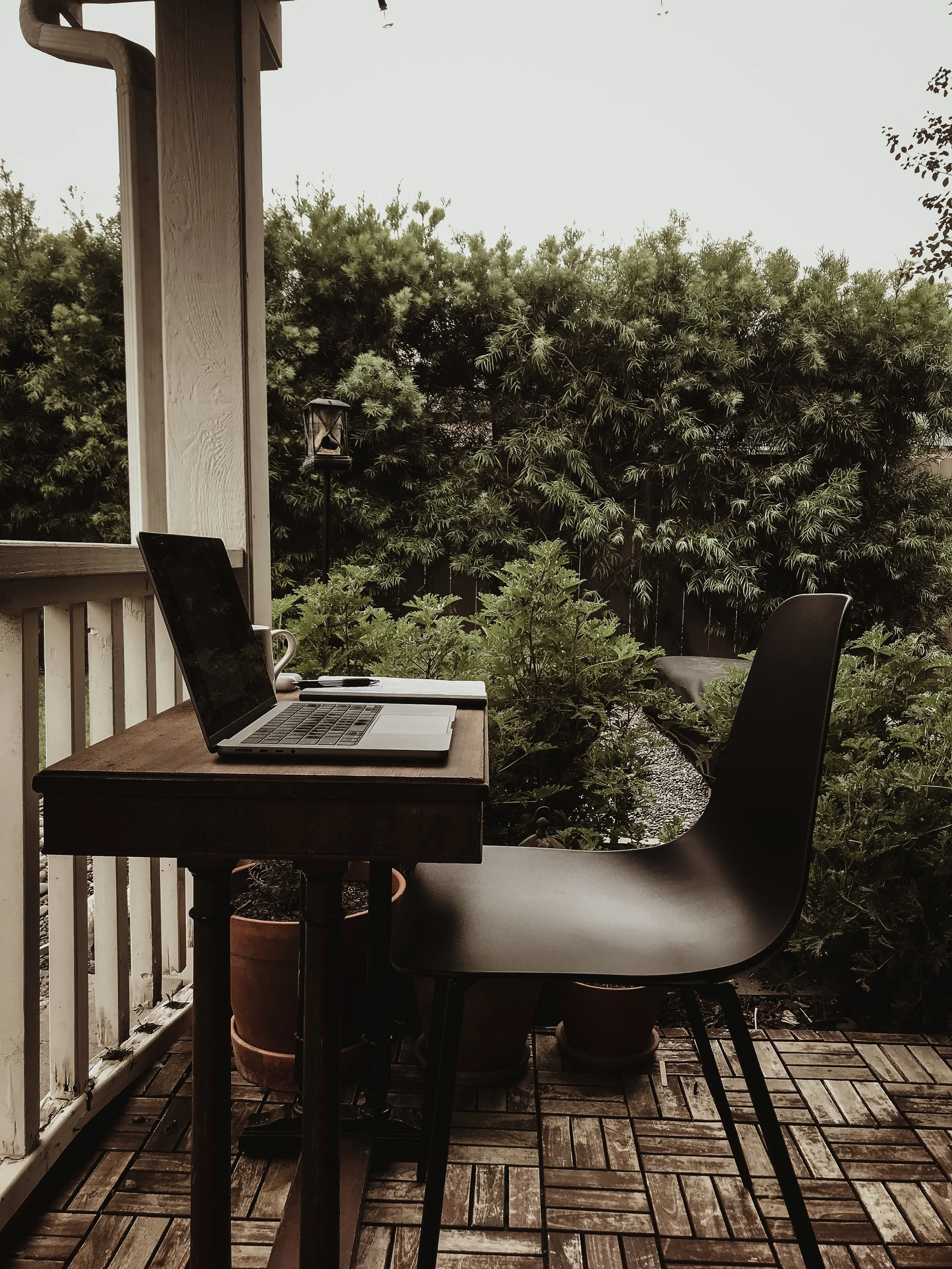
Being in nature can stimulate the senses and stave off lethargy. Spending time in nature can reduce mental fatigue, help with focus, and sharpen thinking. Regardless of whether someone lives in the country in an urban center, spending time near or in green spaces can be revitalizing. So, why do we coup ourselves up in our little offices at work or at home, firmly planted in front of screens, if we know that nature is good for us?
For one, smartphones put in our hands the entire world and all the information we desire. And yet, although the screens are getting sharper, what we see on a screen is merely imitation. I believe our brains truly desire authentic experiences, but we keep feeding them with two-dimensional substitutes. Another reason for the lack of time in nature is a shift in cultural norms toward screen-heavy indulgence. If I told people I sat outside in my backyard and did nothing but sit and enjoy the greenery for two hours, I would get stranger looks than if I shared that I binge-watched the latest popular television for four hours.
As a writer, it is vital to keep my mental faculties sharp and active while writing stories. Writing outdoors has made me feel more energetic, and I have a clearer mind. It is as if sitting at my comfortable desk with all my carefully chosen art pieces causes a collection of mental cobwebs if I am not willing to stir for my seat for too long. Inside, I have to strategically minimize noises and distractions, whereas outside noises, smells, and sounds become an element of assistance. Inside, I have to hide my phone and promise myself not to scroll through the internet. Outside, I almost forget that I have a phone and that my attention is more fully engaged. Inside, the whirling, beeping, humming, and stirring sound of technology keeps me on edge as if I am being watched or surrounded. In the open air, the buzzing of technology disappears, and the vast space of nature swallows the high-pitched humming sounds of devices.
Here are a few reasons why I schedule writing sessions outdoors:
1. Fewer distractions
Although I may get distracted by the noise of a neighbor or a passing bird, they are less distracting than when I am inside. There is only so much time I can stare at a plant or watch a hummingbird. Inside, I remember all the numerous tasks on my list. I am more tempted to watch a show, do a home project, or tidy up. I waste more of my time staving off anxiety and nervousness by sitting and thinking about my long list of what still needs to be done. My outdoor writing table is small, only large enough for my laptop and a cup of coffee. My desk inside has all my notebooks, notes, my kid's school papers, and any other notices I am responsible for. Having a smaller, uncluttered space provides more room for writing.
2. More inspiration
Outdoors, there is more room for my imagination to flourish. The fresh air stimulates my mind, so I can do more difficult imaginative exercises. My motivation to write increases when I go outside because although no one can see me in my backyard, I feel exposed. When I write away from home, I am determined to look like I am writing, and because I act like it, I actually do it. Being more relaxed also stimulates my imagination.
3. Increased productivity
Suddenly, unplugged from an outlet, and with my coffee cooling at a significantly higher rate, there is a mental push to get my work done. Being disconnected from “the grid” in a sense, only having so much battery life, my phone inside, and with no home maintenance distractions, I find I am more productive.
4. Fresh air
No humidifier or air purifier can replace the real sensation of fresh air. In San Diego, I am fortunate to have a temperate climate, making writing outside year-round possible. Even in damp, frigid, warm, or humid climates, it is still possible to enjoy the benefits of nature. A writing session may be twenty minutes instead of two hours, but every little bit helps and allows the body to just breathe a little.
Writing outdoors is not the silver bullet to prevent distractions. It is merely another tool, another option to spur on more productive and better writing. Stepping outside is a physical, emotional, and mental disconnect from the fast-moving world that can be found at the tips of our fingers. Outside, everything slows down. The trees are growing unseen, animals stir in their hidden coves, and the wind blows without what seems to be any rhyme or reason.
I have found my time writing outdoors to be incredibly rewarding. There are fewer redundancies, fewer wasted sentences, and better descriptions when I write outdoors. If you have not given writing outdoors a go, I suggest trying it out. Who knows, perhaps the element of nature is what your writing needs.
Cover Image: Joshua Shaw. Solitude, 1818. The Art Institute of Chicago