JUNE 2024 READING LIST
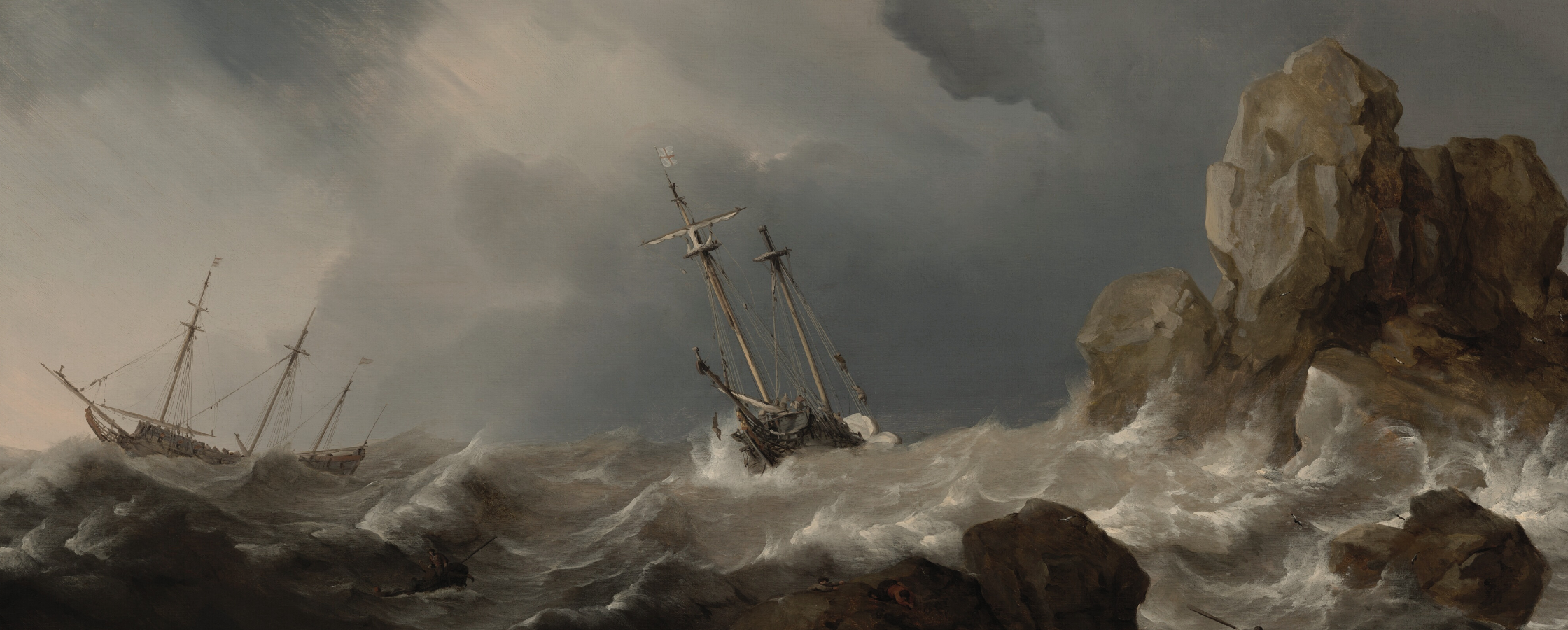
Willem van de Velde the Younger. Ships in a Gale, 1660. National Gallery of Art
THE WAGER BY DAVID GRANN
A British vessel set sail with several other ships to challenge the Spanish Empire’s vast armada in the 1740s. It disappeared after rounding the South American cape, and nothing was heard until a battered raft made it back to civilization and told a tale of brutalist tyranny, savagery, and starvation. Seen as heroes, the survivors basked in national glory until another ship arrived. Three sailors returned to active shores with a different tale. The men who had previously arrived were not heroes—they were mutineers.
First, I was captivated by the image used for the cover of The Wager. I particularly like it when books use art as a cover image. The colors of the front cover were also beautiful and captivating. Second, I appreciated Grann’s preface to the story. He briefly shared his research approach, in which he found information but left the answer to the mystery undecided. He allows the reader to think for themselves, leaving an opening for individual conclusions.
The book reads more like nonfiction in parts, especially when Grann is explaining the settings and environments. It was easy to picture the ports in England, the high seas on a ship, and the lands of South America with the facts and details he described. Then, when people enter the story, Grann writes in such a way that I felt as though I was reading a novel.
There was also attention given to describing the factions that formed after the crew was lost from their flotilla and shipwrecked on a desolate island. Very reminiscent of Lord of the Flies, but instead of boys, they are grown men who should be presumably old enough to forsake the more hideous nature of human survival. When sides are ultimately chosen, and the two groups return to the center of the English empire, there are again the two factions who attempt not only to sway the king and commanders but also the public citizenry.
I enjoyed reading The Wager because I am a fan of historical events that still influence us today. At the end of the book, Grann shares how the story has inspired writers and led to many beloved nautical classics. Two lines stuck out to me. One is the English sailor's view of the native people who lived in the southern archipelago. The English had an inferior notion of the native people, even though the people knew how to hunt, live, and thrive in such a hostile environment. Comparatively, those who washed ashore from His Majesty’s vessel turned to violence, theft, tyranny, murder, and even cannibalism.
“By portraying the natives as both magnificent and less than human, Europeans tried to pretend that their brutal mission of conquest was somehow righteous and heroic.”
The other line lends itself more to the idea of how an empire is created. The victor indeed writes history, but more to the point of success is what the writers of history leave out. What are the tales and stories they choose to omit in order to maintain both power and prestige amongst the populace and to other nations?
“Empires preserve their power with the stories that they tell, but just as critical are the stories they don’t—the dark silences they impose, the pages they tear out.”
4/5 Stars
Jules-Ferdinand Jacquemart. Tropical Plants, 1863. The Metropolitan Museum of Art
WILLIAM HOWARD TAFT PRESIDENCY BY LEWIS L. GOULD
I made it the William Howard Taft in my presidential biography challenge. Based on the recommendations by Best Presidential Bios, I decided to read a Taft biography by Lewis L. Gould and The Bully Pulpit by Doris Kearns Goodwin. Gould’s book focused solely on Taft in his presidency. Typically, I look for a biography that covers the president’s entire life, even their parent’s lives. The WHT Presidency was informative, but much of what I read had already been covered in Edmund Morris's books about Theodore Roosevelt.
The writing was better than some biographies I have read. I truly believe no other biographies will come close to the dry dullness of James Monroe’s bio or the three books about Benjamin Harrison. Even so, this book was an ok read. I found myself reading through it quickly, gaining some insight, but wanting to learn more about why Taft made it to the highest office and what nature and nurture led him to be the man he was.
3/5 Stars
Étienne Delaune. Bellona, 1558–72. The Minneapolis Institute of Art
AN EMBER IN THE ASHES BY SABAA TAHIR
An Ember in the Ashes is a dystopian fantasy young adult novel with a setting similar to ancient Rome, with the brutal Martial Empire. Part of the ferocious regime is a soldier, Elias, who wants to leave the blood and brutality of Blackcliff Academy behind. Laia, a lowly scholar, becomes a slave in the house of a fierce, ruthless woman. Their lives intertwine as the search for a new emperor begins, and secrets long kept hidden become known.
I was drawn to the synopsis of this book, thinking the series would be a fusion of genres—historical fiction meets a dystopian world. There are certainly elements of Romanesque rule, but the military rule of this book seems far more brutal. There is a strong plot involving magic and fantasy that I was not expecting. Much of the book utilizes supernatural forces as elements of the story. Ghuls, ghosts, efrits, and spirits appear in many different ways for good or evil.
I liked the competition parts of the book, even if they felt somewhat reminiscent of The Hunger Games. The Trials each candidate had to go through were physical, psychological, and emotional. I also enjoyed the layer of the story about the Resistance and how Laia and her family played a part in fighting against the Empire.
An Ember in the Ashes had many great lines. Some helped with the flow of the story, and others provided great life lessons, such as:
“Life is made of so many moments that mean nothing. Then one day, a single moment comes along to define every second that comes after. Such moments are tests of courage, of strength.”
A great line about guilt:
“There are two kinds of guilt: the kind that drowns you until you’re useless, and the kind that fires your soul to purpose.”
A powerful line about fear:
“Fear is only your enemy if you allow it to be. Too much fear and you’re paralyzed. Too little fear and you’re arrogant.”
Lastly, the line that sums up the book and is essentially a theme throughout the series:
“As long as there is life, there is hope.”
Another part of the book I liked was how Tahir wrote about each character. She would use descriptive words that were not the typical way to describe people.
“You killed my mother, who had a lion’s heart, and my sister, who laughed like the rain, and my father, who captured truth with a few strokes of a pen.”
She added words that invoked different senses rather than just descriptions. Some of the descriptions felt a little over the top in the more romantic scenes, but compared to other books, I found the scenes in this book far more tolerable.
Trigger Warning: The setting is of a brutal militarist regime. There are scenes with a lot of blood, master/ slave brutality, and several scenes that either mention or have elements of rape. I typically have a tough time with some of the more brutal descriptions, but being that this was a young adult book, the violent scenes were not as savage as some books for adults that I have read about with the Vikings or the Assyrians.
4/5 Stars