FEBRUARY 2024 READING LIST
Anonymous. Northeast Transept of Canterbury Cathedral (recto); Architectural Details (verso), ca. 1800. The Metropolitan Museum of Art
TIME AND CHANCE BY SHARON KEY PENMAN
In When Christ and His Saints Slept, there was a battle between monarchs and the authority of the throne; Time and Chance is about the battle between England’s King and the Church in the person of Thomas Becket. First designated as chancellor and later made Archbishop of Canterbury, begins the battle of wills over who decides the fate of the English: is it God or the King?
Henry II's ambition has made him the most powerful monarch in the world, yet his home life is fraught with scandal, seduction, betrayal, and Becket's continued reluctance. Henry rose to power with his beautiful and powerful wife, Eleanor of Aquitaine, and a good friend as his chancellor, but by the end of the novel, Henry may find himself alone.
I was excited to continue the story of Henry II and his beautiful new bride, Eleanor of Aquitaine, and, at first, there was all the intrigue of crown against crown as the French King and the King of England challenged each other for dominance. The story then began to focus heavily on the relationship between King Henry and Thomas Becket, whom he had appointed Archbishop of Canterbury, the most powerful church figure in England.
This book read much more slowly than the first, as it meandered through the fraying relationship between the Archbishop and the King. Penman’s research is impeccable, and I could see traces of what would lead to Henry VIII's final bullying effort to rip the church away from the authority of Rome and establish the church under the kingship. The unraveling of the relationship between Henry and Eleanor was also intriguing and began to involve their children, several of whom are well known in history.
The slower pace did make for a less exciting read. As I read the accounts of the King and the Archbishop going toe-to-toe with each other over who was greater, the king or God, I felt conflicted. On one hand, I felt as though Penman could have shortened the entries about the arguments between Becket and Henry, as the book is fairly long. And yet, the numerous accounts where Becket did not forfeit the church to the king entirely were needed to show the exasperation of the King and what was at stake. Henry II was not trying to manipulate the religious order to achieve the successful birth of a legitimate male heir like his descendant, but he was still attempting to bend the church to his will.
Time and Chance may have been a slower read, but its contents help clarify what happens in the books that follow. This would be a wonderful book to read during the winter months, when one has more time to read, as the days are shorter and offer a dark, gloomy ambiance that is perfect for a medieval read about betrayal.
Camille Corot. Mother and Child, probably 1860s. The Metropolitan Museum of Art
THE MIDWIFE: A MEMOIR OF BIRTH, JOY, AND HARD TIMES BY JENNIFER WORTH
A young Jennifer Worth, leaving a life of comfort and a man she cannot have because he is married, finds herself at a convent in the slums of post-war London’s East End. She meets an array of colorful people as a district nurse and as a midwife, delivering babies throughout the area. She spends her evenings with spirited, warm-hearted nuns and fellow valiant midwives. During her days, she helps a woman who can’t speak English deliver her twenty-fifth baby, delivers babies of mixed race with varying reactions, and delves into the dark and prevalent world of prostitution as she attempts to help a young pregnant prostitute.
For all the dark and challenging themes around abortion, poverty, prostitution, and abuse, The Midwife is beautiful and honestly written. Utterly moving and powerful, the stories from Worth’s experience in the East End will touch the hearts of mothers everywhere.
I was nervous to read this book after reading reviews about the difficult subject matter of abuse, prostitution, abortions, and the despair of the workhouses. I checked out this book, but I was too scared to read it, so I returned it. Then, for some reason, I picked it up again and thought I would skim through the first few pages and see what I thought. I was immediately drawn in. I am a big fan of the show, and so many of the stories were not new to me. Even so, I could not help but be fascinated by reading Worth’s own words to describe the East End of London in the 1950’s.
The first several chapters provided introductions to the main people Worth interacted with between weekly clinic, her rounds as a midwife, and as a district nurse, while also bringing to life the conversations and relationships she made while at the House of St. Raymond Nonnatus (the author mentions the name is a pseudonym). The show stayed fairly faithful to the book, though there were some minor alterations to details. What was so captivating about the stories was how hopeful Worth made things out to be. She gives a bleak history of the absence of midwifery in the centuries before, and the groundbreaking work of the Sisters of Nonnatus. Although the stories of the poverty-stricken and those fatigued by two wars were grim, to say the least, there was an essence of promise and hope in the storytelling.
One story was extremely difficult to get through, one where she encounters a young woman, Mary, who is a prostitute, escapes the house where she ‘works’, finds help with a church order, but later has her newborn child taken from her. Reading about the “Cafes” where tawdry and erotic shows were put on night after night was both eye-opening and repulsive. One scene was absolutely terrible and almost impossible to read. And yet, somehow, it did not seem that shocking because the world is full of darkness. One of the most disheartening lines was how prostitutes were dragged into brothels at the ages of fourteen or fifteen, like Mary in the book. Today, that age is now ten.
Even amid the bleakness of poverty in the middle of the 20th century, the rough life lived by the docks and the desperation of women, Worth still conveys a story of hope and shares the joy of motherhood in a profound and heartening way. I finished the book with joy rather than sorrow. Educated, but not cynical. The Midwife is a good book to read to gain a better understanding of a world not that long ago, but for the most sensitive souls, it may be too much.
Eugene Higgins. Poor Folks, 20th century. Harvard Art Museums
SHADOWS OF THE WORKHOUSE BY JENNIFER WORTH
Shadows of the Workhouse follows Jennifer Worth’s first book, Call the Midwife, where she shares about working near the docks of East London during the 1950’s and tells stories of the people she encounters along the way.
The first story is about Jane, an illegitimate daughter of an aristocrat, who is sent to the dreaded workhouse. Then we meet Peggy and Frank a follow both their journeys in and out of the workhouse where they were separated for many years. Later comes the arrival of a reverend to Nonnatus house, who seems to have some chemistry with Jane. Finally, the eccentric Sister Monica is accused of shoplifting, which leaves nuns and midwives at Nonnatus with heavy hearts and concern.
These stories, and others, provide fascinating insight into the spirit and character of ordinary people who find ways to overcome their difficulties and desperation we can hardly imagine.
I found Shadows of the Workhouse to be extremely educational about the attempts to create a welfare system before the current welfare system was put into place. Worth writes with such hope and optimism, even when describing the harrowing tales of the workhouse. She describes them as the state’s first attempt at helping the poor, and although they were a good idea in theory—employ and house the destitute, orphaned, and widowed—without regulation, accountability, or minimal standards of decency, cleanliness, and care, workhouses became a dreaded existence.
Worth is a wonderful, honest storyteller who can weave past and present stories together in her narrative in a most natural way. I liked that, as I read what was happening with Jenny in the story, she brought in history and past stories to help add context and provide a more well-rounded perspective. The final part about the wars was interesting but also a little dry. Once the story delved into Joe, the old soldier's present state, the book's pace quickened, and I could not put it down.
There are difficult themes in this book around poverty, physical abuse, and war. This book was less difficult to read than the first, more so because Shadows of the Workhouse shared less about sexual abuse, and even though the dreadful conditions of workhouses and the suffering people endured were hard to read, I could manage.
James McNeill Whistler. Grey and Silver: Old Battersea Reach, 1863. The Art Institute of Chicago
FAREWELL TO THE EAST END BY JENNIFER WORTH
Farewell to the East End is the final book of Jennifer Worth’s memoirs of her life as a midwife in London’s East End during the 1950s. There are heartbreaking stories of a family afflicted by the scourge of tuberculosis and a young woman, the captain’s daughter, who ‘serviced’ the entire crew and discovered she was in labor. There is also quite a lot of humor in the story of two women who share a husband, Chummy delivering triplets, and a backed-up chimney flue. Along with these stories, some tales venture into the world of backstreet abortions, infanticide, and the changing landscape of the docks while continuing to share the warming stories of the inhabitants of Nonnatus House, including a wedding.
In Farewell to the East End, I found the perfect balance of the two previous books by Worth. There are plenty of hardships and rough tales around the world of delivering babies, and the wretched conditions of the poorest part of London. And yet, the book was hopefully even endearing in sharing the more humorous tales and reminding the reader that, regardless of one’s situation, one must carry on. The story of Megan’Mave was fascinating and tracked harmoniously with the PBS version. Chummy comes to life a lot more on the pages as she solely delivers triplets, has to steer the proceedings around delivering a baby on a boat, and finds her match in a man in the police force.
The story of the backstreet abortionist was difficult to get through, as well as the case of infanticide and the tales shared by the older nuns at Nonnatus House about what they had witnessed in their time. Even so, every story was both beautiful and, at times, heartbreaking. Worth does a wonderful job of not making light of difficult topics or of sweeping them under the rug. She shares accounts with realness and honesty, but always with a ray of hope. Whether a story is joyous or wretched, Worth writes in a way to make each person’s story valuable and worth knowing.
Not once did Farewell to the East End lag, and no section became tedious or overly traumatizing. I read through this final memoir quickly, and even though the content was difficult, I found myself saddened that Worth’s tale of a bygone era was over. Even though societies are, in many ways, better than 75 years ago, there is still so much to learn and so much improvement to be had. Here in the US, we may not have had The Blitz or the workhouses, but we have our worn, torn neighborhoods and the mangled ruins of our own attempts to assist the enslaved or the destitute. Worth’s memories have given me a better understanding of the harrowing history of pockets of humanity, while also offering hope and optimism, never painting anyone in a bad light and encouraging us all to be decent human beings and contributors to a better society.
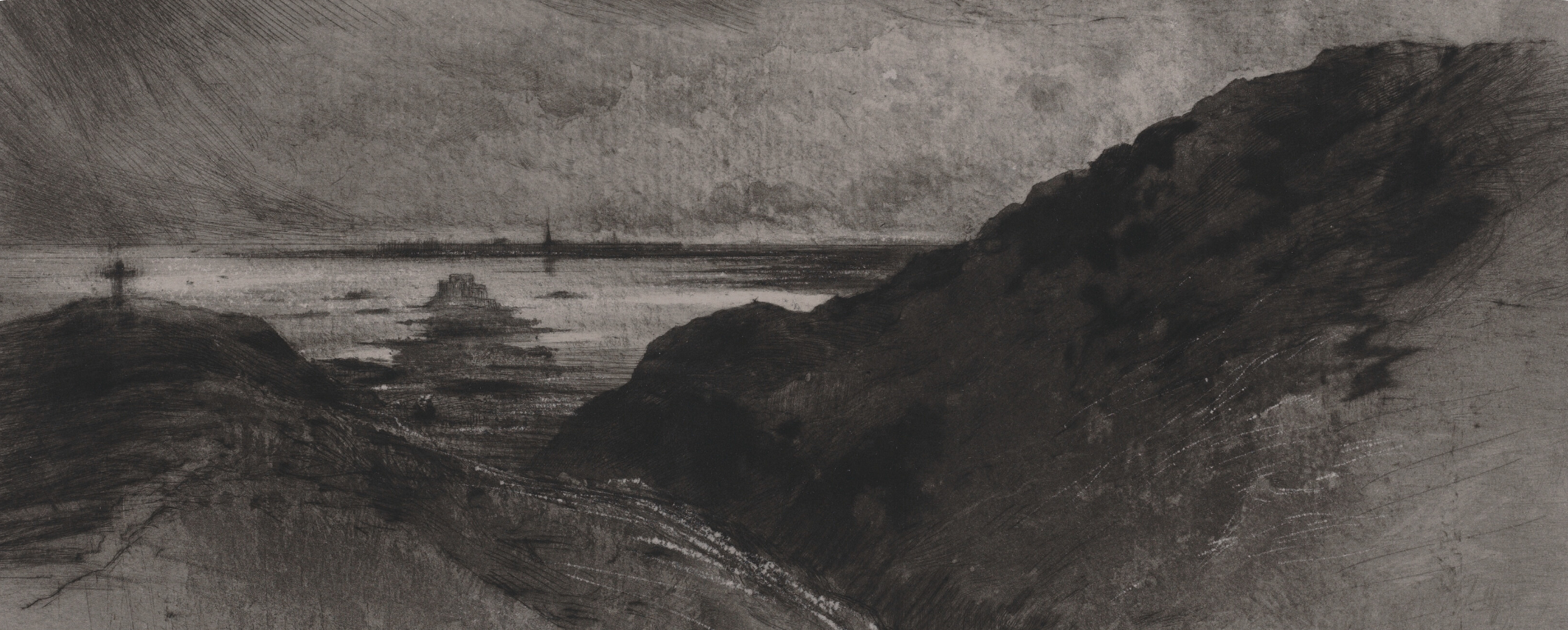
Félix-Hilaire Buhot. The Cliff - Bay of Saint-Malo, 1889–90. The Metropolitan Museum of Art
ALL THE LIGHT WE CANNOT SEE BY ANTHONY DOERR
This is a beautifully written story about a blind French girl and a German boy whose paths cross in occupied France as they each struggle to survive the devastation of World War II.
I read All the Light We Cannot See nearly a decade ago, when it was first published, and I greatly enjoyed the way the two stories of Werner and Marie-Laure were woven together. It was magical the first time I read it, and with the newly arrived series adaptation, I thought I would read the book again.
The second reading did not disappoint. Again, I was transported back in time and to a place world away from my own. I read about the care and concern the paternal figures have for Marie-Laure and her own bravery in taking part in the resistance. I was also reminded of Werner's poverty-stricken path and his brutal time at the National Political Institute of Education at Schulpforta before being sent to Saint-Malo, where his world collides with Maria-Laure.
The back and forth of the two narratives, as well as the change in dates, can be a bit jolting if one is not used to it, but I liked the way Doeer steers the story, starting with the penultimate days of German occupation, while slowly and steadily filling in context and ambiance throughout the book. The magic of this story is Doerr’s ability to focus not on one side as good and one side as bad; instead, he writes in a way that makes me root for both Werner and Marie-Laure. Two young people on opposite ends of the war, but in reality, are more connected and relatable than the world would make them think.
There is so much symbolism and dire warnings as to the toxicity of greed and ruthless power in this book. The cruel and vicious measures of a hypocritical state that manipulated and indoctrinated the poor and desperate to force on them the attitudes of a heinous regime. The portrayal of each character’s life was also well done, avoiding a happy ending that would have made the book less believable. Instead, the losses and those who survived, each with their victories and defeats, added depth and profundity to the story, thereby rendering it more believable, even if it is fictitious.
Regarding the Netflix series, I have found myself in the camp of the purists, those who would have liked to see the story told as it was in the book. For one enormously important reason, for a country that should be reminded that every country has done terrible things and we should remember them as terrible and own up to our failure, the US is one of them. The idea that the series ends in a more hopeful place conflicts so much with the story I read. War scars the winners and the losers in different ways, but no one leaves unscathed. We need to be okay with stories not having happy, hopeful endings because many people in this world live such lives.
Second, I might also find myself in the minority, but I preferred that there be no courtship or real love interest between Maria-Laure and Werner. Something about the happening of two strangers, who find themselves on opposite sides of a war, being presented to each other, and just finding the humanity in the personification of one’s opponent. This spoke considerably to the futility of war, and in the end, it is one group of people attacking another group of people—shedding blood that all runs red. I also think it is an easy path for writers, for film or literature, to always return to the relationship tropes. The fact that they do not become lovers, but are internally affected by each other’s existence, speaks to the power of relationships beyond the romantic and distinguishes the story even more.
I will end with the statement that I believe the book far and away exceeds the film adaptation, both in depth and pace. I love films, and I am not opposed to some creative license, but to lose the story's effectiveness and not replace it with something more meaningful is a missed opportunity and a source of disappointment for the avid reader.